

As a mid-thirty year old father, long gaming sessions are now a distant memory, and handheld gaming is the perfect antidote. I can grab a small device, at the end of a long day, whilst I’m on the sofa or in bed and play for a few minutes before I inevitably pass out from exhaustion. I don’t have time, nor the inclination to sit in front of a TV to have long drawn out gaming sessions, but if I did, it’d be retro games for me, and it’s simply not convenient for me, and let’s face it, most people, to have older consoles setup in the family home.
My trusty PSP has been at my side since it’s release, and although I still have a great fondness for it, my tired eyes aren’t what they used to be, and the small PSP screen isn’t exactly ideal nowadays - not to mention using the analogue stick is a pretty dreary experience.
The Steam Deck and the Nintendo Switch were both obvious choices for me, I can tinker with the Steam Deck, installing retro games and the hundreds of steam games in my backlog that I’ll never get to, and the Switch can serve as an all important Nintendo first party console. There is however, a catch. In their own ways, they both achieve a great deal and I’ve spent many hours with them over the years, but they just never had that “portable” feel to them in the same way a PSP, a DS or a gameboy had. I love the idea of a console-like experience at my beck and call, wherever I am, but the Steam Deck hasn’t had its moment in the sun (literally) as it’s just too bulky for me to consider taking anywhere further than up and down the stairs.
My Handheld Journey
I recently picked up an Anbernic RG447M upon watching a Digital Foundry video, which really sold the idea of a 4:3 handheld to me. Most of the games I had emulated in the past had also been 4:3 games, and as someone who despises wasted screen real estate, a native 4:3 device just seemed perfect for me.
I had fun setting up the device, putting a few of my favourite games on there, and even played through an entire run of Pokemon Leaf Green. Unfortunately, there’s just a few gripes with the device that I just couldn’t get past. Some see the metal chassis as a premium feature, when actually (at least for me), it felt slightly too heavy, cold and industrial - It almost felt like those YouTube videos you see where people build prototype handhelds that always feel slightly unfinished.
The face buttons were great, as was the d-pad, but the shoulder buttons were definitely a huge drawback for me. Not only are they side-by-side on the device, they also click incredibly loud, almost like a mouse from the 90’s, which when you’re trying to play Tony Hawk Underground at midnight next to someone sleeping, is far from ideal - almost impossible.
Then came along the Retroid Pocket Nova. I’ve never had a Retroid device, but they seem a little more polished than the Anbernic counterparts, so I had to get an order in to try it for myself.
Hardware
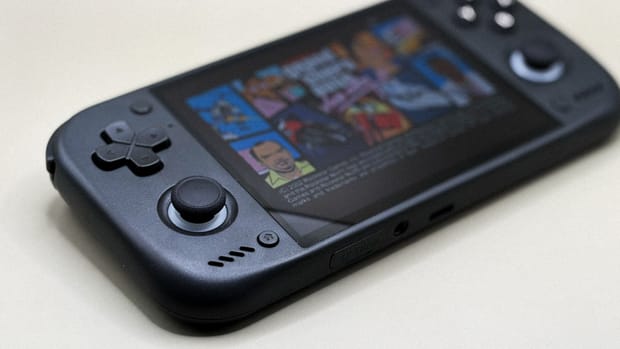
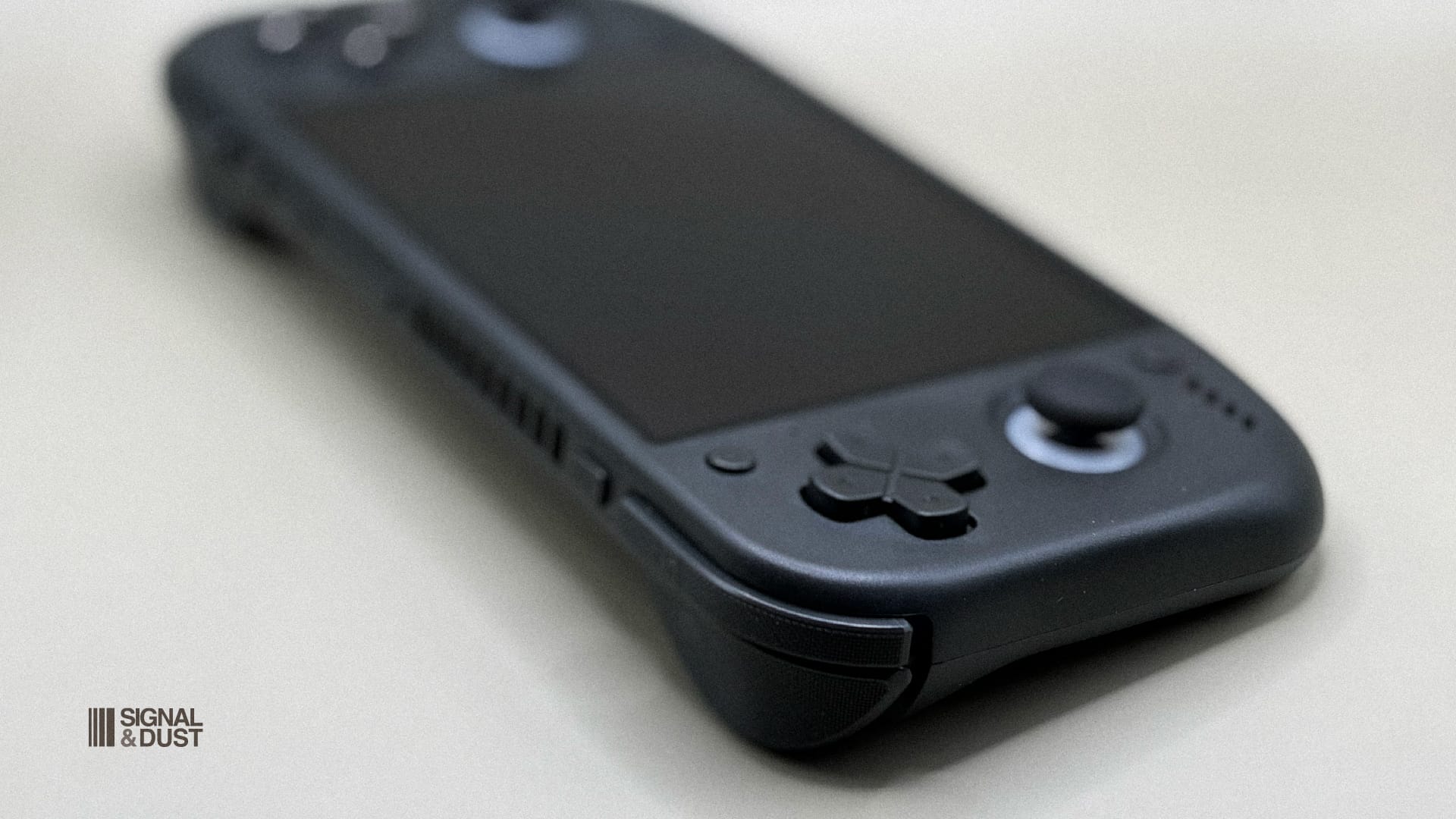
The Retroid Pocket Nova feels as good as you might expect from a device like this. The finish is quite nice, but the plastic still feels a little cheap compared to something like the Steam Deck. The buttons have a little play in them, which feels slightly unsatisfying.
The D-Pad is fine but feels a little over sensitive, which I’m sure is fine for 2D games. When I tested the D-Pad on Vice City (and I know it’s an odd choice, but I have played Vice City using the D-Pad on multiple systems since, and including the PS2), it was rather twitchy and hard to control.
The shoulder buttons are again, fine, but are small for my fingers and the angle felt like I was slipping off them a lot. The bumpers are easy to reach but have a very slight jagged edge and are slightly louder than I’d ideally like.
The analogue sticks work fine, but if you’re holding the device comfortably, they’re hard to use. You have to angle your thumb down quite significantly, which is very unergonomic, especially for long play-throughs.
The screen is known to be the biggest reason to purchase this device, and it’s nice seeing an OLED 4:3 screen on a handheld, but I would definitely say the importance of an OLED is widely exaggerated. Sure, it’s nice having the dark blacks, but if you’re buying this purely because it’s an OLED, I’d think twice.
The device itself feels pretty good to hold, but if your hands are on the bigger size, a device this small might be a problem. I often play on a PSP, which also has this issue, but also feels much nicer to play. The D-Pad on the PSP is far more satisfying to use, as are the face buttons.
This is far from a “premium” feeling device, but it’s nice enough if you can handle the quirks.
Software
The biggest downfall of these devices (at least for me), is the Android operating system. I know there are many different launchers you can use, and you can also try various Linux distros, but under the hood, you still have to deal with Android, which just doesn’t feel like a natural gaming experience to me. You’ll often have to use the touchscreen to navigate certain settings, which always feels like a hindrance. Even adjusting the volume with the buttons shows the android volume slider, reminding you that you’re essentially using a phone with some controllers attached to it.
I know Retroid is a small company, but if they could eventually work toward a native operating system, a more bespoke experience that felt a little more “console”, these devices would feel so much more polished than they currently do. I imagine in the future, Linux will become more widely used on devices like these, which can only benefit such devices due to the open source nature and let’s be honest, keeping google at arms length is never a bad thing.
The Steam Deck is a great example of what a handheld device (that isn’t a Switch) is really capable of. The Steam OS just works, feels intuitive and you never feel Linux peeking through the frontend.
Performance
We're at the point now, where all performance for this device has been documented as the chipset is the same as the Retroid Pocket 6. Unfortunately, this is an instance where video content beats written word, so if you're concerned about performance of something specific, YouTube is your friend.
I tried out a handful of games from the PS2/Gamecube era, and didn't have any issues running anything, for example Tony Hawks Underground, GTA Vice City and San Andreas.
The device can handle some switch emulation, but it's really not suitable as the screen aspect ratio means you'll be either running a very small 16:9 window, or stretching it out, neither of which is ideal.
If you're looking to play anything from the Gamecube / PS2 era, then performance won't be an issue for you (although there may be some capability quirks). Anything from previous generations will run without a problem.
Some PC games will be playable via something like GameNative but from my experience, it's not perfect and with the time you'll spend messing around, you'd really benefit from playing PC games on a different system like a Steam Deck.
In conclusion
I know that a smaller company like Retroid cannot possibly compete with the likes of Valve or Nintendo, but that doesn’t also mean I don’t expect a certain level of quality for £200. I’m also aware that having an Android system wouldn’t bother a lot of people, but I’m now at the point in my life where I don’t have time to be fiddling around quite so much. I want to pick up a handheld device, and just play. No running through menus, launchers, different apps, changing settings. Just pick it up and play it.
If you feel like you can deal with the Android backend creeping through even when using a launcher, the thumbsticks being hard to use and the D-Pad being relegated more to 2D games, and also do not own something more comfortable like a Steam Deck, then this device could be worthwhile for you.
For now, I’ll be sticking with my Steam Deck and Switch 2. If I really need something smaller to grab on my way out of the house, my trusty old PSP will always be there waiting.